passage
James 1:5 Explained: Asking God for Wisdom
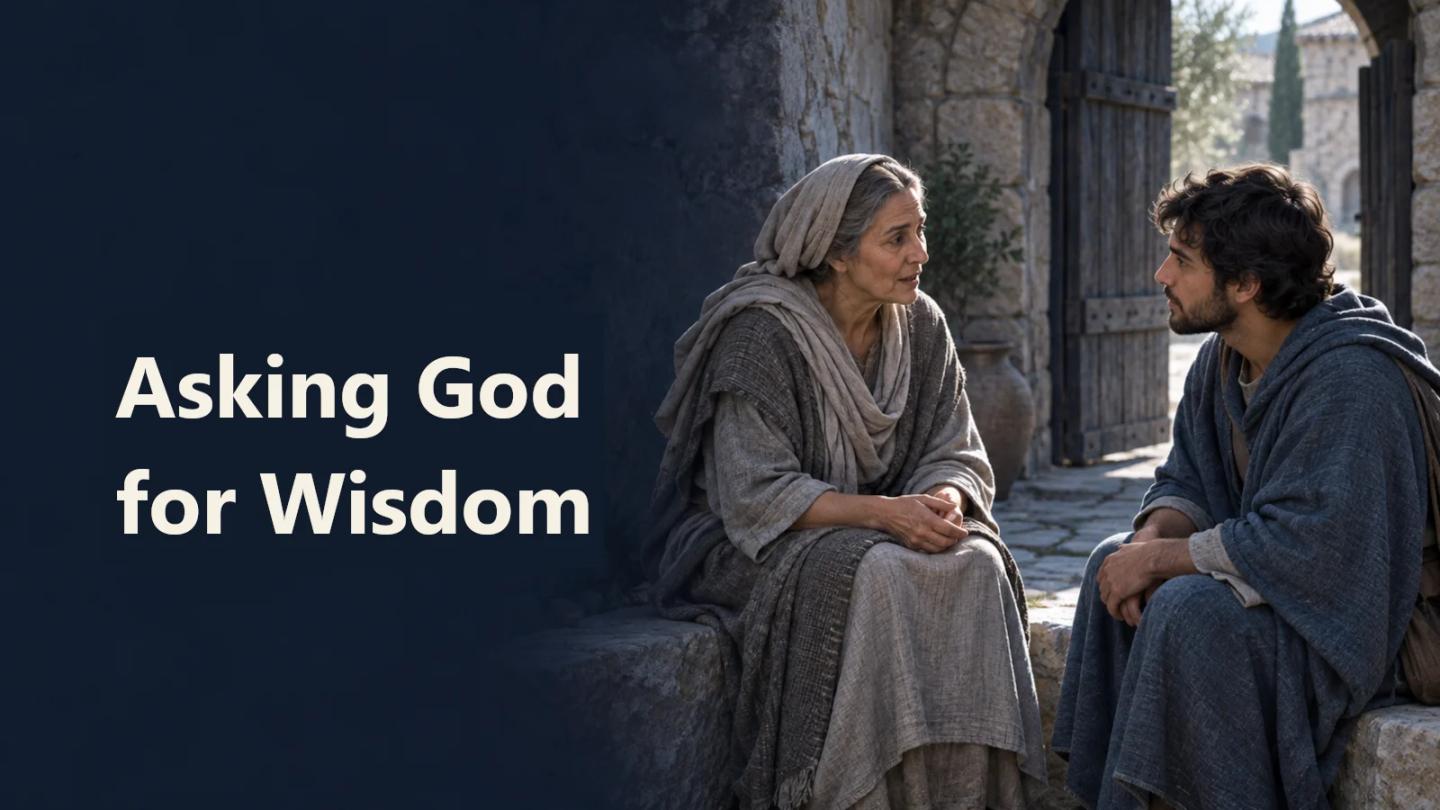
James invites those who lack wisdom to ask the generous God in faith. In the setting of trials and endurance, this means wisdom for faithful living; it does not promise an audible answer or certainty about every choice.
Updated October 14, 2026
Passage: James 1:5 (WEBP)
Literary setting: James 1:2–8: trials, endurance, maturity, and asking God for wisdom in faith.
At a glance
Meaning in brief
James 1:5 invites people who lack wisdom to ask God, who gives generously without humiliating them for their need. In the surrounding discussion of trials and endurance, the gift is best understood as wisdom for faithful living and growth in maturity. Asking in faith means trusting God; the following warning challenges wavering, divided trust. It does not promise an audible answer or complete certainty about every decision.
The passage in context
Count it all joy, my brothers, when you fall into various temptations, knowing that the testing of your faith produces endurance. Let endurance have its perfect work, that you may be perfect and complete, lacking in nothing. But if any of you lacks wisdom, let him ask of God, who gives to all liberally and without reproach, and it will be given to him. But let him ask in faith, without any doubting, for he who doubts is like a wave of the sea, driven by the wind and tossed. For that man shouldn’t think that he will receive anything from the Lord. He is a double-minded man, unstable in all his ways.James 1:2–8 (WEBP)
The word “temptations” here describes the trials in which faith is tested. James’s concern is endurance and a mature life. The next invitation answers an admitted lack: if you need wisdom, ask God.
The movement from “lacking in nothing” in verse 4 to “lacks wisdom” in verse 5 helps connect the subjects. Commentators differ about how closely the two paragraphs belong together. The Expositor’s Greek Testament treats the wisdom paragraph as a new subject, while Cambridge’s commentary and the USCCB notes recognize a connection with the preceding discussion. Reading the invitation in its surrounding context best accounts for the repeated lack language and James’s concern for faithful conduct. That does not restrict every application of the verse to a crisis.
What does wisdom mean in James?
Wisdom concerns how a person understands and lives before God. Later, James asks the wise person to show it through good conduct and gentleness (James 3:13). In verses 14–18, jealousy and selfish ambition are contrasted with wisdom from above, which is pure, peaceful, gentle, reasonable, merciful, and fruitful.
These qualities help explain the gift sought in James 1:5. The reader needs wisdom to respond faithfully, rather than simply more information about what will happen next. In a trial, that can mean seeking how to act with integrity, patience, or mercy while the outcome remains unknown.
This wisdom can also shape ordinary decisions. But the verse’s immediate setting should guide its explanation. For the broader question of choices, counsel, and responsibility, see How Do I Know God’s Will for My Life?.
God gives generously and without reproach
James directs the request to God and says that wisdom “will be given.” This is a real promise of God’s help, not merely encouragement to feel more capable.
“Liberally” describes generous giving. The commentaries also explain the wording in terms of giving freely or without reservation. “Without reproach” means the person asking is not humiliated for needing wisdom. Admitting that need is part of the invitation.
Keep “gives to all” together with the instruction to ask in faith. It is not a promise that every request, whatever its purpose, receives the desired result. James later distinguishes asking with wrong motives from faithful asking (James 4:3). God’s generosity does not make every desire wise.
Asking in faith, without doubting
Verse 6 calls for trust in God. Its wave image describes a person whose trust is unstable, pushed one way and then another. The warning in verses 7–8 is serious: the wavering, double-minded person should not presume to receive from the Lord.
The doubt in view includes wavering about God’s reliability. James also uses “double-minded” when calling people to purify their hearts in James 4:8, in a context of divided loyalty. That wider use helps explain the warning. Both unstable confidence in God and divided allegiance matter here; “double-minded” should not replace the meaning of doubt with a label for ordinary indecision.
Do not turn this into a demand for certainty about your own judgment. Trust that God gives wisdom is different from being sure that you have interpreted a feeling, circumstance, or possible answer correctly.
An honest question, an anxious thought, or uncertainty between two options should not automatically be labeled double-mindedness. The passage does not provide a test for diagnosing a reader’s faith from an unresolved decision. At the same time, it does call readers to examine whether they are willing to receive God’s wisdom rather than accept only what suits their wishes.
What does the promise include?
| Focus | What James affirms | What this passage does not establish |
|---|---|---|
| Gift | God gives wisdom to the person who asks in faith. | A flawless choice or advance knowledge of every outcome. |
| Asking | Trusting dependence on the generous God. | Certainty that your own impression cannot be mistaken. |
| Receiving | A genuine promise of wisdom. | A specified timetable, audible voice, vision, or unmistakable feeling. |
| Trials | Wisdom for faithful living as endurance develops. | Removal of every difficulty or an explanation of its cause. |
God is the source of the gift, but James does not specify one delivery mechanism. The absence of an audible-answer promise does not mean God can never guide a person specifically. It means that this passage cannot guarantee that experience for every reader or decision.
Asking for wisdom today
Begin with an honest request for the wisdom you lack. Remain willing to receive correction and to act faithfully, rather than treating prayer as a way to secure an outcome you have already chosen.
Prayer can accompany learning, reflection, and counsel. Proverbs 2:1–11 brings seeking understanding together with receiving instruction and recognizing God as wisdom’s giver. These are responsible ways to seek wisdom; they are not a guaranteed sequence hidden inside James 1:5.
When a trial or decision remains unresolved, consider the conduct James associates with wisdom: gentleness, mercy, peace, and good fruit. Ask what faithful action is possible with the knowledge you have. You may still need more information or help; this passage gives no deadline for complete clarity.
For a related explanation of wholehearted trust, read Proverbs 3:5–6 Explained. For prayer and anxiety in a different literary setting, read Philippians 4:6–7 Explained.